What Is Montessori Education? A Complete Guide for Parents
Montessori is one of the most recognized names in early childhood education—but what does it actually mean? This guide explains the Montessori method in plain language for parents considering a Montessori preschool.

If you have been researching preschools in Round Rock or anywhere in Central Texas, you have almost certainly come across the word Montessori. It comes up in school names, curriculum descriptions, and parent reviews. But what does Montessori actually mean—and how does it differ from a traditional preschool?
This guide explains the Montessori method in plain language, covers what a Montessori classroom actually looks like, and helps parents decide whether it is the right fit for their child.
The Origins of Montessori
The Montessori method was developed by Dr. Maria Montessori, an Italian physician and educator, in the early 1900s. Working with children in Rome who were considered difficult to educate, she developed an approach based on careful observation of how children naturally learn.
Her core insight was this: children are not empty vessels to be filled with information. They are naturally curious, self-motivated learners who, when given the right environment and materials, will teach themselves.
Over the past century, the Montessori method has been adopted by schools around the world and validated by decades of research in developmental psychology and education.
Core Principles of the Montessori Method
Child-Led Learning
In a Montessori classroom, children choose their own activities from a prepared set of materials appropriate to their developmental level. Rather than a teacher delivering a lesson to the whole class at the same time, children work independently or in small groups on activities they have selected.
This self-direction develops intrinsic motivation—the internal drive to learn—which is one of the strongest predictors of academic success.
The Prepared Environment
The Montessori classroom is designed intentionally. Materials are arranged on low, accessible shelves. Everything has a specific purpose and a specific place. The environment itself teaches: children learn to care for their space, return materials after use, and move purposefully through the room.
The prepared environment eliminates unnecessary stimulation and distractions while providing rich opportunities for focused work.
Hands-On, Self-Correcting Materials
Montessori materials are physical and hands-on. A child learning to sequence numbers does not do a worksheet—they manipulate wooden beads or counting rods. A child learning letter sounds traces sandpaper letters with their fingers before writing.
Many Montessori materials are also self-correcting: the child can see or feel when something is not right and adjust accordingly. This builds problem-solving skills and reduces the need for constant teacher correction.
Mixed-Age Classrooms
Traditional schools group children by exact age. Montessori classrooms typically group children across a three-year age range—for example, ages 3 to 6 in the Casa program. This mirrors natural family and community structures.
In mixed-age classrooms, older children reinforce their learning by helping younger peers. Younger children learn by observing older children. Social skills develop organically across different developmental stages.
Respect for the Child's Pace
Montessori education respects that children develop at different rates. There is no expectation that every child masters the same skill at the same age. Teachers observe each child closely and introduce new materials when the child is ready—not on a predetermined schedule.
This individualized approach reduces the pressure and anxiety that can come with rigid academic benchmarks in early childhood.
What Does a Day in a Montessori Preschool Look Like?
A Montessori morning typically includes a long, uninterrupted work period—often 2 to 3 hours—during which children choose their work, move freely within the classroom, and engage in focused, self-directed activity.
You will see children:
- Working alone with Montessori materials on rugs or at tables
- Helping each other or observing a peer's work
- Engaging in practical life activities like pouring, folding, or caring for plants
- Working with sensorial materials that build discrimination and order
- Practicing early literacy through phonics objects, sandpaper letters, or the moveable alphabet
- Exploring math concepts with concrete bead materials
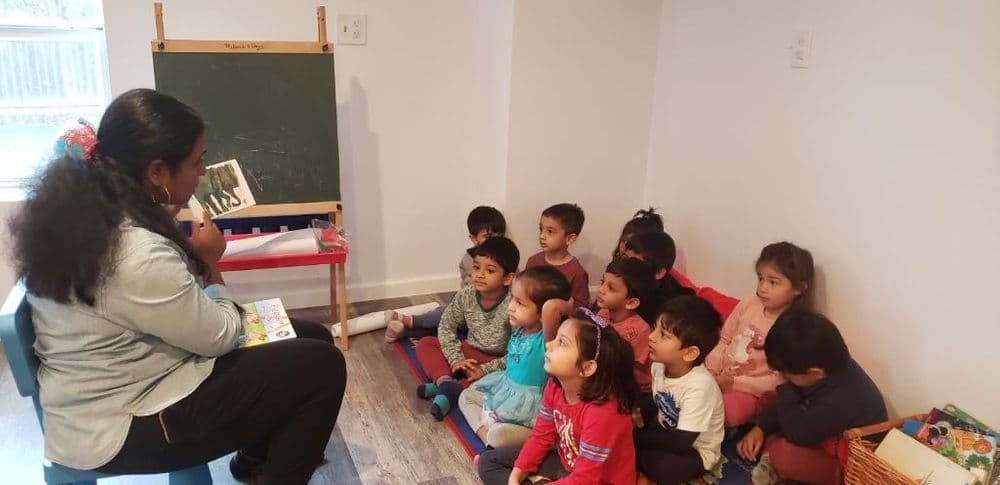
There is usually a group circle time for songs, stories, and classroom community, and outdoor time for gross motor development and nature exploration.
Montessori and Academic Preparation
One of the most common questions parents ask: will my child be academically prepared for kindergarten in a Montessori program?
The research consistently says yes—often ahead of peers. Studies show that children who complete Montessori preschool programs tend to enter kindergarten with stronger literacy and math skills, better executive function (self-regulation, attention, flexibility), and stronger social-emotional skills than peers from traditional programs.
This is partly because Montessori introduces academic concepts in a concrete, hands-on way that supports deep understanding rather than rote memorization.
Is Montessori Right for Every Child?
Montessori works exceptionally well for most children, including children who are very active, children who learn by doing, children who are highly independent, and children who struggle in rigid structured settings.
It can require adjustment for children who are very used to being directed or entertained, or who find open-ended choice overwhelming at first. Most children adapt within a few weeks once they understand the freedom and structure of the Montessori environment.
If you have specific concerns about your child's needs or learning style, it is always worth discussing them directly with the teachers at any program you are considering.
Montessori at Learning House Preschool
Learning House Preschool in Round Rock has offered Montessori-inspired early childhood education since 2008. Our three programs—Nido for infants (6 weeks to 18 months), Maison for toddlers (18 months to 3 years), and Casa for preschoolers (3 to 6 years)—each apply Montessori principles in ways appropriate to the developmental stage.
Our classrooms are stocked with authentic Montessori materials. Our teachers, including Ms. Sandhya, who holds Montessori training alongside an engineering degree, and Ms. Reena, with over 25 years of early childhood experience, guide children through individualized learning paths that honor each child's pace and curiosity.
Parents consistently tell us how surprised they are by the depth of learning their children achieve—and how much their children love coming to school.
If you are interested in Montessori preschool in Round Rock, schedule a tour and see our Montessori classrooms in person. Contact us at (512) 238-9851 or learninghousepreschool@gmail.com.